
Topical authority is more important than keyword density for AI SEO, as LLMs evaluate semantic meaning, context, and entity relationships rather than just counting exact keywords.
For a long time, for SEO strategists and managers, keywords were the way to rank a web page higher in search engine results. However, after Large Language Models (LLMs) came, the rulebook completely flipped, and now it is about building topical authority and showing relevance to rank and be cited in AI references. In fact, a 2026 study of 4 million AI Overview URLs by Ahrefs found that 37.9% of pages cited in AI Overviews also appeared among the first 10 SERP blocks.
This study highlights the importance of building topical authority, instead of being consistently fixated on ranking traditional SEO to rank higher and higher. Thus, they also need to understand the difference between topical authority vs keyword density to form a better strategy for performance.
What Is Topical Authority?
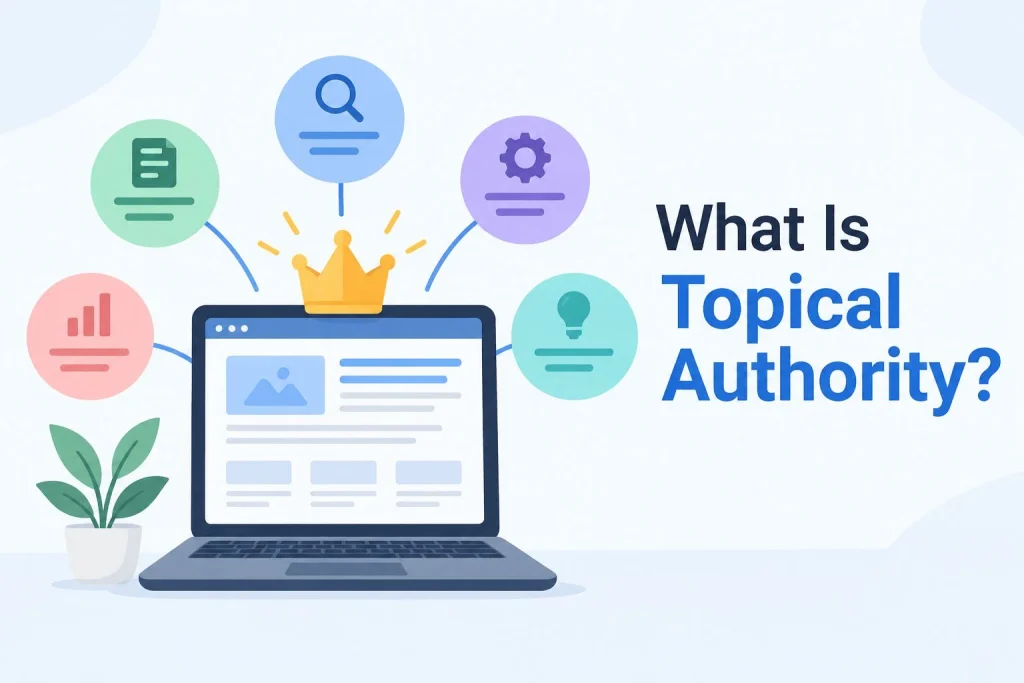
Topical Authority can be understood as the level of expertise, authority, and credibility of a website over a specific search query of the user. It is about creating content that is relevant to what users are asking about a certain niche, which also makes it easier for AI models to interpret and cite it in answers as references.
What Is Keyword Density?
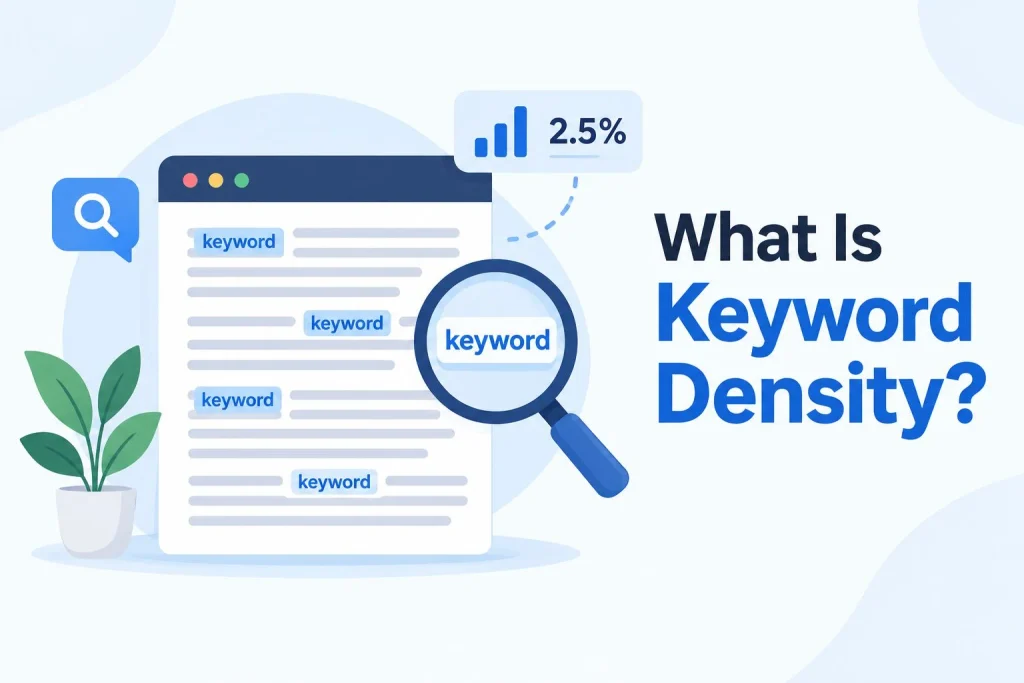
Keyword Density is the percentage of how many times the target keyword appears on a web page in comparison to the total word count. For instance, if your target keyword is added 5 times in a 500-word blog, the keyword density is 1%
In addition, as modern search engines prioritize semantic search or meaning-based search to understand context, simply adding keywords and expecting to be cited in AI would not work.
Topical Authority vs Keyword Density: What’s the Difference?
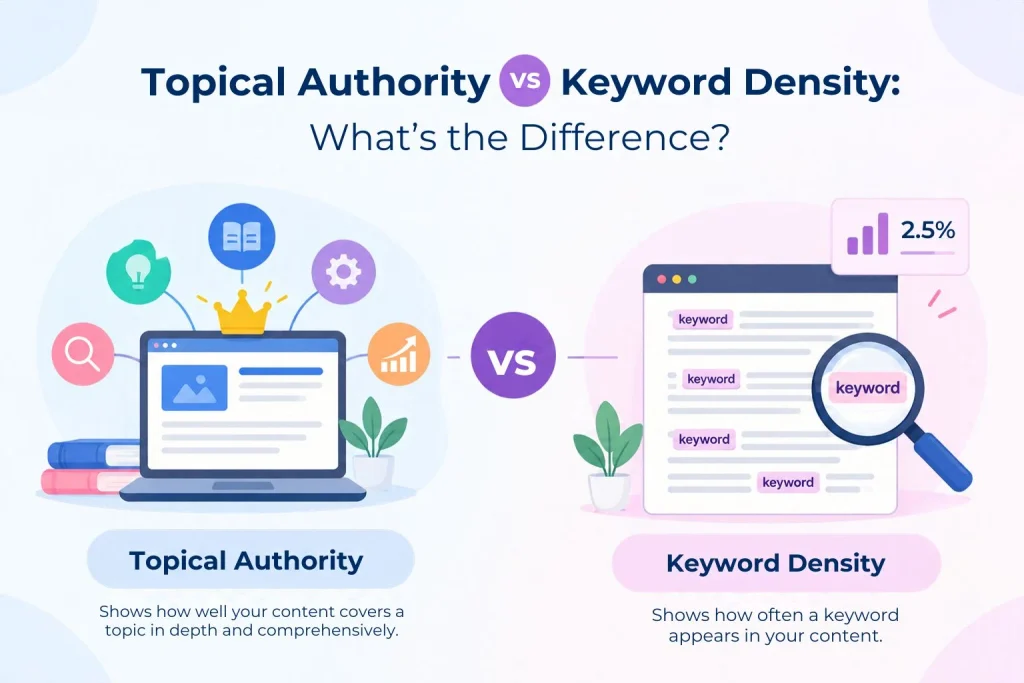
Look at the table below to know the difference between topical authority and keyword density:
| Factor | Topical Authority | Keyword Density |
| Meaning | Demonstrates broad, credible coverage of a topic | Measures how often a keyword appears |
| Primary Focus | Topic depth, relevance, entities, related subtopics | Exact keyword frequency |
| Typical Measurement | Topic coverage, content depth, internal links, expertise signals | (Keyword mentions ÷ Total words) × 100 |
| Example | Covers SEO, crawling, indexing, backlinks, technical SEO, AI search, E-E-A-T | Uses “SEO strategy” 10 times in 1,000 words = 1% |
| Content Approach | Answers the main question + related user needs | Repeats the target term naturally |
| Search Intent | Addresses multiple aspects of the user’s intent | Primarily tracks term usage |
| AI Search Relevance | Helps establish contextual relationships and topical coverage | Not a standalone measure of AI visibility |
| User Experience | Prioritizes useful, comprehensive information | Excessive repetition can reduce readability |
Topic breadth + depth + credibility
Does Keyword Density Still Matter for SEO?
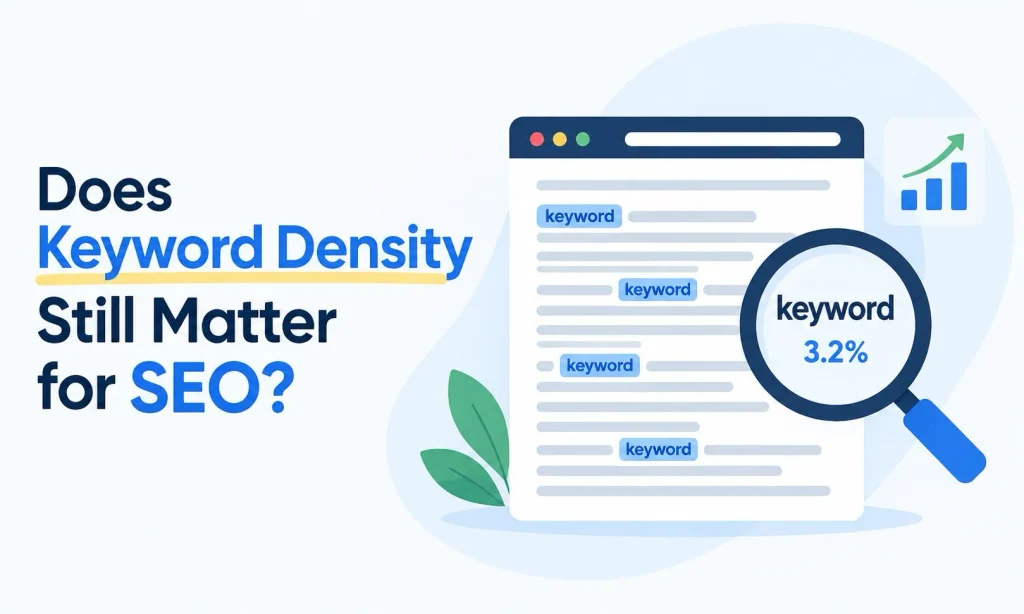
Keyword density, in the present-day scenario, does not directly affect your web page’s ranking on the search engine. It does matter to ensure that the content stays on the right path while also not disturbing readability. But as search engines and AI models now prioritize semantic relevance, relying on keyword density may not perform well if you want visibility in AI search results.
Therefore, does keyword density matter for SEO? Yes, keyword density is still relevant in terms of traditional SEO, but AI SEO will require content that is relevant, useful, and answers the user’s query directly.
Why Topical Authority Matters for AI SEO
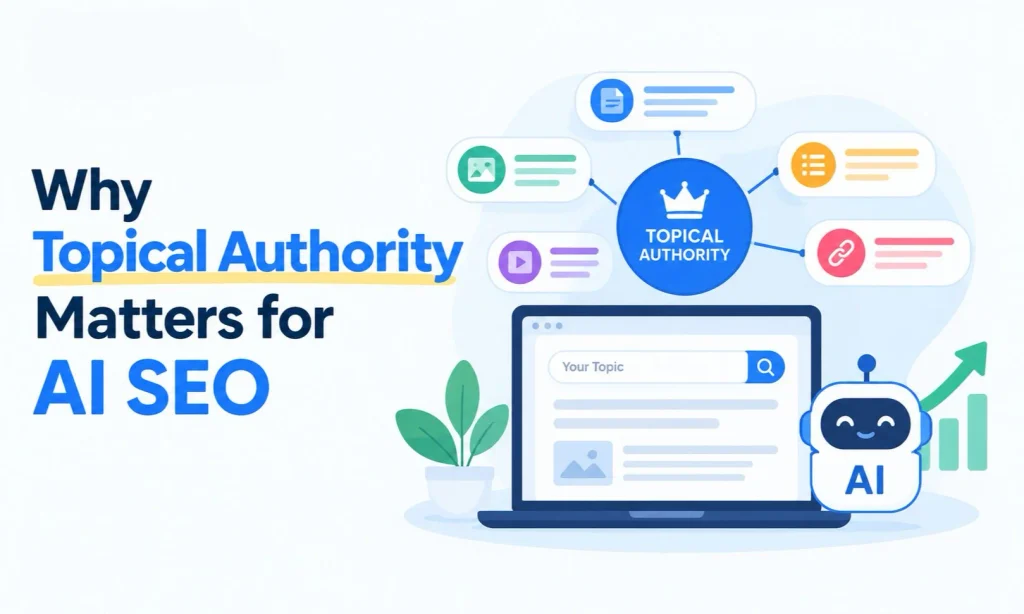
Topical authority is important for AI SEO because AI search engines do not look for content that only repeats the target keyword. They value content that clearly understands and covers the specific niche query and provides relevant information within a well-structured format.
To support this, let’s take a look at a 2026 study by Semrush on AI Search Intent, in which content cited by AI showed 32.83% better clarity, 30.64% stronger E-E-A-T signals, and 22.91% better section structure. Thus, this study showed that content that is clear, easy to understand, and well-structured gets cited more often in the AI search results.
Note: The study was based on the analysis of around 12,000 AI prompts and 60,000 Google SERPs.
How Semantic SEO Connects Keywords and Topical Authority
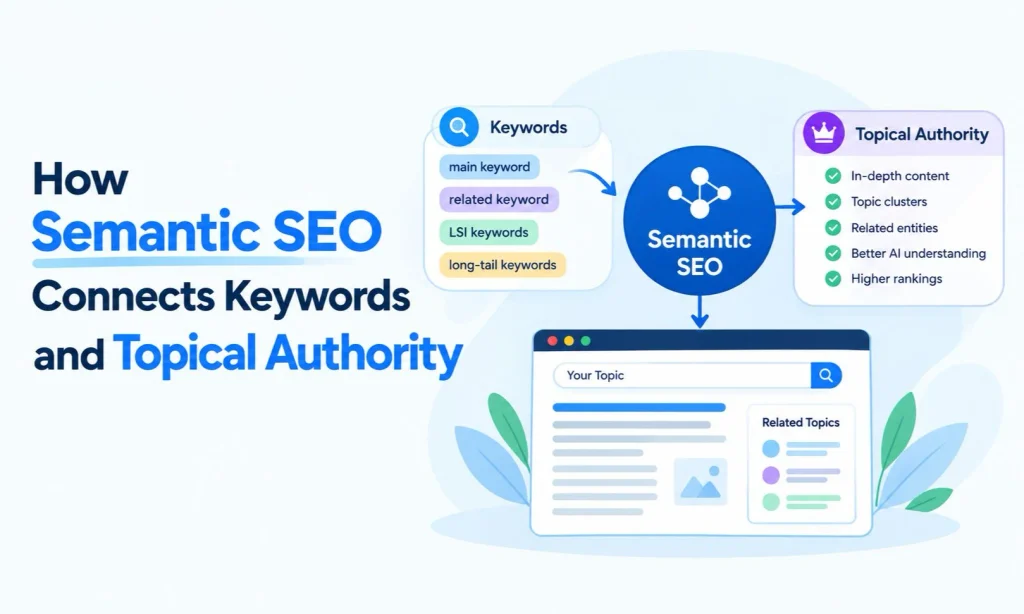
Semantic SEO connects your keywords and topical authority by connecting your target or focus keyword with related terms, questions, entities, and subtopics. For example, if your keyword is “digital marketing service,” it might also include subtopics such as social media marketing, SEO, PPC, and others that you have covered in your content.
Therefore, by showing a wide coverage of the topic regarding digital marketing, you will show search engines that you have the right expertise and information, further helping in building topical authority.
How to Build Topical Authority Step by Step
Here is how you can build topical authority step-by-step:
1. Conduct Topic and Keyword Research
Choose the relevant keyword centered around your topic by conducting user research and using SEO tools. You can also use the “People Also Ask” section or auto-suggestion feature to search related queries.
2. Build a Topical Authority Map
Build a map for topical authority SEO by making structured main topics and their specific subtopic clusters. List every question, subtopic, idea, and data related to that main topic and organize them using manual or AI tools, whichever suits better.
3. Structure with Pillar Pages and Top Clusters
Design a structure that acts as the central destination for the main topic and create supporting or subtopics within its hierarchy. Then, link every cluster to the main pillar page and create cross-links between the topics as well.
4. Publish High-Quality Content
When you write content, always follow the E-E-A-T guidelines in it by adding real-world valuable insights, data, statistics, and case studies. Also, add visual content, such as images, videos, infographics, and graphs, if needed to support the context and increase engagement.
5. Implement Internal Linking
Implement internal linking among your web pages. Add links that lead users to related topics, your service, or product page. This helps the search engine crawl your website easily, which increases the chances of it being cited in AI search results as well.
6. Keep the Content Updated Regularly
Another important thing is to ensure that the content on your web pages is always up to date. Whether in blogs, service or product pages, pricing pages, about us, portfolio, and other pages
How Topic Clusters Strengthen Topical Authority?
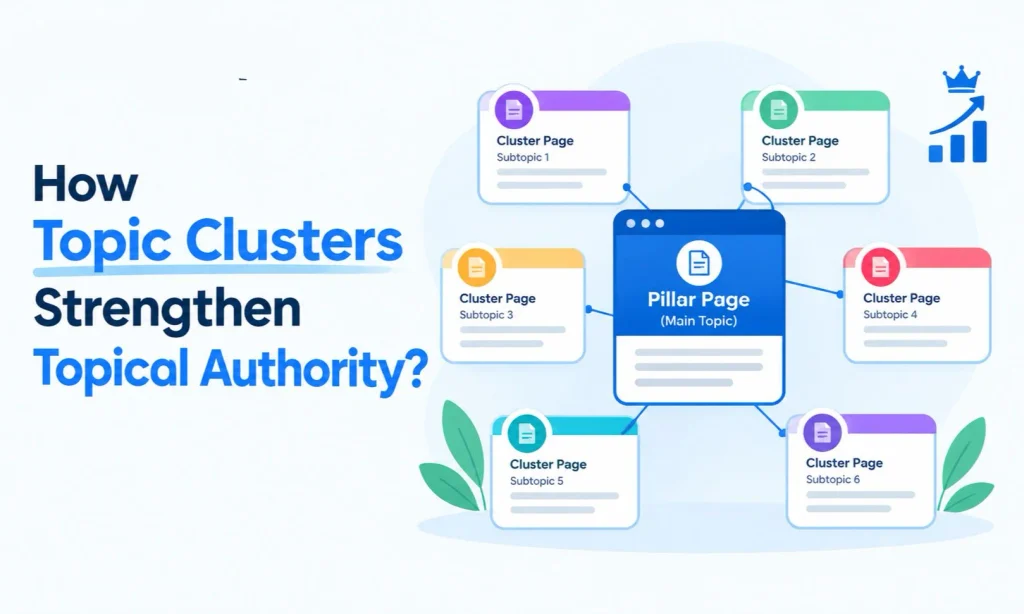
Topic clusters build a strong topical authority by organizing related content around a central theme or pillar page on the website. It signals to search engines and AI systems such as AI Overviews, ChatGPT, and Gemini your expertise in that specific area or topic.
Here is how topic clusters work:
- Helps AI Understand Content
Topic clusters set up a strong contextual and semantic relationship as they link a single pillar to smaller, subtopic sections. This helps AI search engine crawlers understand the semantic hierarchy of your content.
- Support AI Citation
AI search engines depend on entity-based ranking and query fan-out to find the best answers. And because you have included valuable information and data and created sub-topic clusters, it is more likely that your content will be cited in answers given by AI models.
- Increases User Engagement
When users stay on your website for a long time due to well-structured, valuable content and interlinked pages, it signals search engines that your website is relevant and trustworthy.
How Does Internal Linking Support Topical Authority and Keyword Relevance?
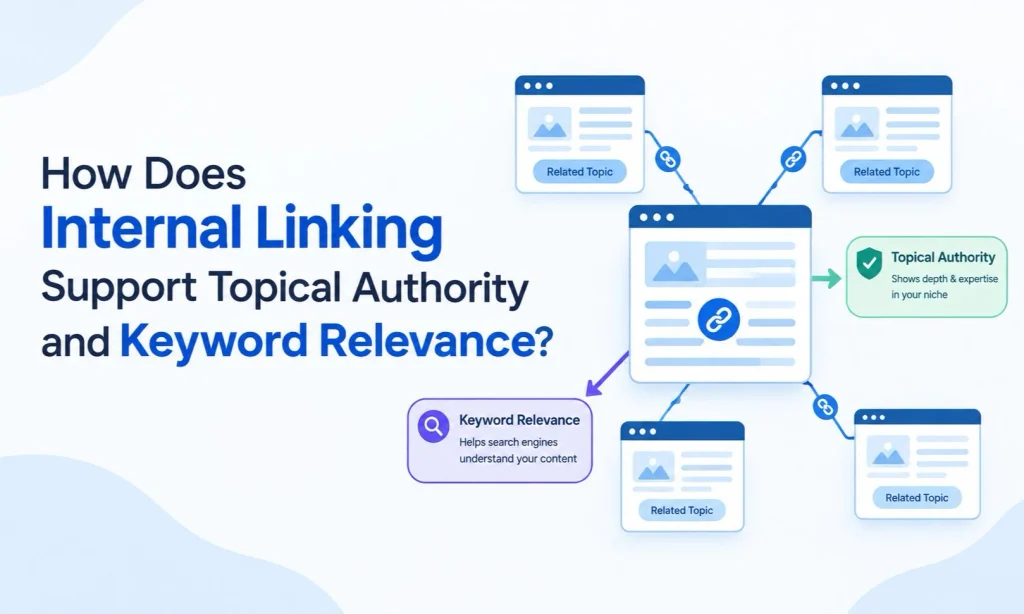
Internal linking supports topical authority through:
- Connecting related pages or topic clusters within the same topic or pillar page.
- Demonstrating content depth and expertise of a specific subject to search engines.
- Establishing a well-structured hierarchy on your website.
Internal linking supports keyword relevance by:
- Making the keyword context strong through relevant anchor text.
- Linking keywords to related pages, helping search engines understand how they fit the main topic.
- Helping search engines understand the main page of the website.
How to Measure Topical Authority and AI Search Visibility?
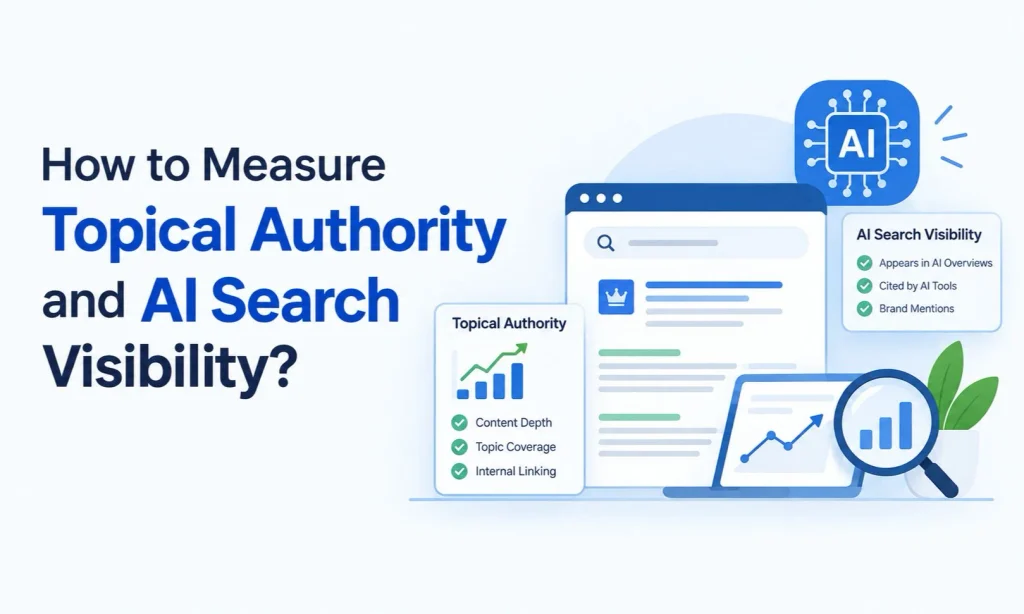
Here is how you can measure topical authority:
- Track topic share and keyword cluster rankings on search engines.
- Analyse the coverage gaps in your content.
- Monitor topic-specific branded searches.
- Audit for internal links and the architecture of the website.
Steps for measuring AI search visibility:
- Track your brand citations in AI Overviews, ChatGPT, Perplexity AI, and other AI search engines.
- Use SEO tools to search your main target keywords and observe what subtopics AI platforms include with your company name.
- Use AI tracking platforms to track your brand mentions and sentiment across all AI platforms.
What Are the Common Topical Authority and Keyword Density Mistakes to Avoid?
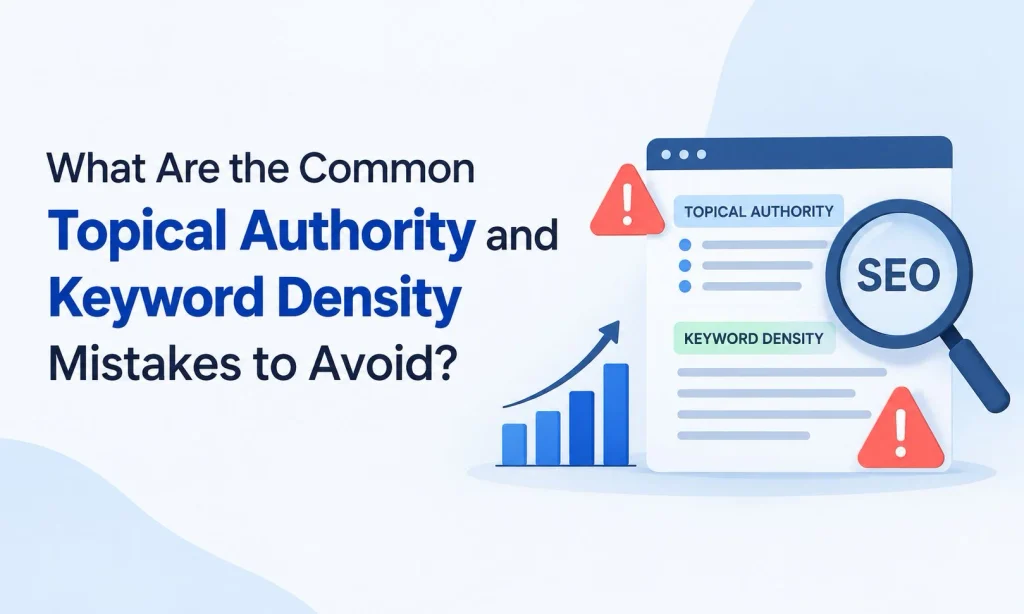
Here are the mistakes that you need to avoid for topical authority and keyword density:
| Topical Authority Mistakes | Keyword Density Mistakes |
| Covering only 1 to 2 subtopics | Repeating the keyword over 10 times unnecessarily |
| Ignoring 5 to 10+ related topics | Chasing an arbitrary 1 to 2% density |
| Creating thin, shallow content | Keyword stuffing to increase density |
| Missing topic clusters | Forcing exact-match keywords |
| Adding 0 to 2 internal links to related pages | Using the same keyword in every heading |
| Ignoring search intent | Sacrificing readability for keyword placement |
| Using outdated or weak sources | Adding keywords where they don’t fit |
| Creating unrelated pages | Repeating the same keyword across multiple pages |
Frequently Asked Questions
1. How long does it take to build topical authority for AI SEO?
Building topical authority for AI SEO usually takes several months of consistent publishing, internal linking, content updates, and comprehensive coverage of relevant topics and subtopics.
2. Can a new website build topical authority?
Yes, a new website can build topical authority by consistently publishing useful, trustworthy content that comprehensively covers its core topic, related subtopics, and relevant user questions.
3. How many articles do I need to build topical authority?
There is no fixed number of articles required to build topical authority; focus instead on covering the important topics, subtopics, questions, and search intents within your niche.
4. Does keyword density still matter for SEO?
Keyword density is not a standalone ranking factor, so there is no ideal percentage to target; use relevant keywords naturally while focusing on search intent, context, topic coverage, and helpful content.
5. How do topic clusters help build topical authority?
Topic clusters connect a central pillar page with related supporting content, helping search engines and AI systems understand the relationships between topics and the depth of a website’s coverage.
6. How can you measure topical authority for AI search?
You can measure topical authority by analyzing topic and keyword coverage, cluster rankings, content gaps, internal linking, and brand or page citations across AI search platforms such as Google AI Overviews, ChatGPT, and Perplexity.
Conclusion
In 2026, to build topical authority for AI SEO, brands need to shift their focus from adding keywords to optimizing content for AI visibility. It is becoming an important aspect for businesses if they want to establish their brand authority and visibility among potential customers. Thus, by writing valuable, relevant, and trustworthy content, they can show their expertise and increase their chances of getting visible across the AI search results.
If you need professional assistance to improve your topical authority across AI search engines, you can connect with Web Glaze Services. As a digital marketing agency in India, we offer the best services to improve your visibility across AI search engines. Our team is committed to offering solutions that suit your business needs and long-term goals. Thus, reach out to us and get the best topical authority solutions today.
Also Read: The Top 10 Reasons Behind Google Reviews Disappearing

