

Brands and website owners must understand that creating valuable content is the only way their SEO strategy can do miracles for them. Many of them are becoming aware of the serious issues of thin content in SEO. This is a major obstacle for websites trying to secure a higher rank in search results in 2026. Search engines are now more advanced and use smarter strategies to assess and index pages.
They now focus more on value, clarity, and user intent and ignore pages with weak information, copied content, and brief explanations. This means thin content can make your website lose visibility and directly affects your traffic and leads. Keep reading, as this blog covers clear steps through which you fix thin content issues. The information in this blog will help you understand how important improving content quality is to secure stronger rankings and better user engagement.
Thin Content in SEO: What It Is & How to Fix It
What is Thin Content in SEO?
Those who are not aware of thin content in SEO need to understand how big this issue is and how badly it can affect their website rankings and effectiveness. This content simply means pages on a site that contain very little useful or original information, or content that provides little value to users. These pages don’t explain topics in detail and lack depth. Pages with short, duplicate, and shallow content can fail to satisfy user intent.
Generally, search engines may rank these pages lower, select another page for a query, or decide not to index them when they provide little value. This means a website with a significant amount of low-value content can make it harder for both users and search engines to understand which pages are most useful. Visitors may quickly leave such pages when they don’t find the information they need, but bounce rate itself should not be treated as a direct Google ranking factor.
Types of Thin Content in SEO
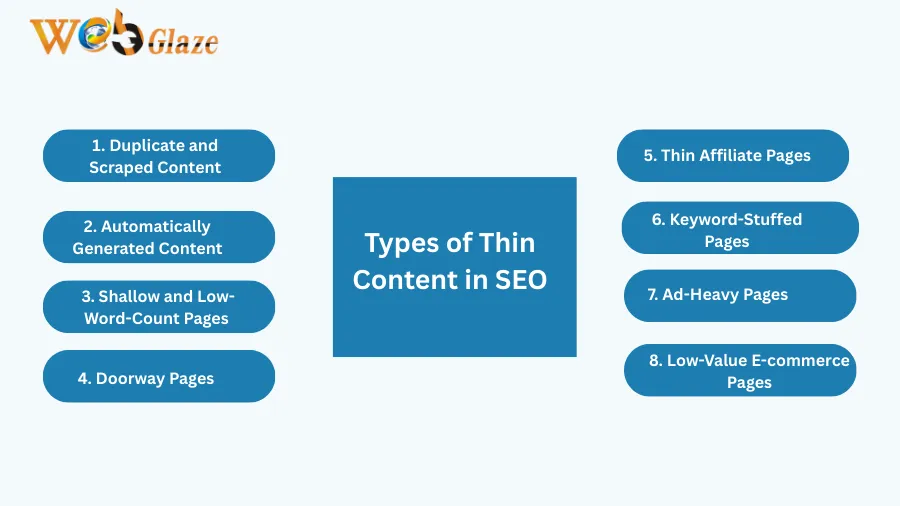
Before you understand how to fix thin content to ensure your SEO strategy works effectively for you, you must know the types of such content. This information will help you easily spot content that is of no value for either user or search engine. Here are the main types of thin content in SEO:
1. Duplicate and Scraped Content
These are texts that are copied from other sites or appear in more than one location on your own site without any modification or added value. Such content can make it harder for search engines to determine which version is the most relevant one to show, and they may select one version rather than displaying multiple similar pages.
2. Scaled or Automatically Generated Content Without Added Value
Content created using software or AI tools is not automatically considered thin content. The problem arises when large amounts of content are produced without sufficient originality, human oversight, usefulness, or added value, particularly when the primary purpose is to manipulate search rankings. Such content may read unnaturally, repeat information, or fail to provide the answers users need.
3. Shallow and Low-Word-Count Pages
These are pages that have very little information that they can’t clearly answer a user’s query. This type of thin content has minimal depth and expertise on the topic related to which the user asks a query. As such pages can’t fully satisfy users, search engines may rank them lower or choose more useful pages.
4. Doorway Pages
These pages are created to rank for specific keywords or closely related search queries and often provide little unique value. They may consist of multiple similar pages created primarily to rank in search results and funnel users toward the same destination. They don’t offer unique information and only interrupt user journeys. Their main purpose is to manipulate search visibility rather than provide a useful experience for visitors.
5. Thin Affiliate Pages
These pages don’t have original or have very less valuable content. They also lack original insights and helpful information. Their only focus is to direct visitors to product pages. So, they contain nothing but affiliate links and sponsored content. Affiliate content itself is not a problem, but pages that provide little original information or value beyond the merchant’s existing content can be considered low-value.
6. Keyword-Stuffed Pages
Content with primary keywords can help you secure the right results; however, pages with content overloaded with keywords only hurt your SEO. In this type of thin content in SEO, the keywords are forcefully or unnaturally added to manipulate rankings. They lack readability and genuine value, so they often frustrate visitors and make them leave your site.
7. Ad-Heavy Pages
Pages where ads, popups, and other clicks dominate the visible area. This causes disruption to the user experience, as it distracts them from the main content. Moreover, these distractions can also affect page experience. However, ad-heavy pages should be treated as a user-experience and page-quality issue rather than automatically classifying them as thin content.
8. Low-Value E-commerce Pages
These are product or category pages with very few descriptions, few images, and don’t provide information in detail. As they don’t provide enough information for visitors to make purchasing decisions, they are a type of thin content in SEO and need to be fixed. Adding original product information, specifications, comparisons, FAQs, use cases, customer insights, or other helpful information can make these pages more useful.
Why Thin Content Is Bad for SEO
Creating high-quality and original content is a must to secure good search visibility. As such content satisfies user intent, websites with such content can be more competitive in search engine results. Those who are not aware of the guidelines set by Google and other search engines for quality content must work with SEO experts and experienced content writers. Here is how thin content hurts your SEO and rankings:
- Lower Search Rankings: Pages with low-quality content on a site don’t meet user needs. So, they can’t compete with pages that offer valuable information. They may receive lower visibility in search results when they fail to satisfy the user’s query.
- Poor User Experience (UX): When visitors arrive on a page with very less information, they may leave quickly. When pages lack valuable answers, users may not engage with the content or continue their journey.
- Reduced Engagement: When visitors land on a page and don’t get expected answers, they leave quickly. For improving user engagement, it is a must to create content with high relevance. This can help you provide a better experience and potentially improve search performance.
- Wasted Crawl Budget: Pages with thin content in SEO can consume crawling resources, particularly on very large websites with thousands or millions of URLs. They could use those resources for crawling and indexing your pages with important content. So, invaluable content can make large websites less efficient to crawl and manage.
- Risk of Penalties: Sites that contain content created primarily to manipulate search rankings, including scaled content abuse, can violate Google’s spam policies and may face ranking restrictions or removal from Search. However, thin or low-value content by itself does not automatically result in a Google penalty. Moreover, unhelpful and low-quality content fails to compel visitors and directly impacts lead generation and sales.
How to Identify Thin Content in SEO (2026)?
Now that you know how low-quality content negatively affects your SEO success, you understand the importance of creating deep and valuable content. Pages with original content that fully answers user questions and matches search intent can provide stronger value to users and improve their ability to compete in search results. Here is how you can identify thin content:
- Use Google Search Console: You can use GSC to check the performance report of pages on your site. However, low impressions or clicks alone do not prove that a page contains thin content. You can check the Page Indexing report for pages that are not indexed and review the reasons provided by Google.
- Perform a Site Audit: You can use tools like Semrush, Oncrawl, and others to find technical issues, duplicate content, and word count variations. With these tools, you can easily assess factors, like the length, depth, and originality of the content on your web pages. Use word count as a supporting metric rather than a standalone measure of content quality.
- Manual Review: You can work with a team of SEO experts and experienced content writers who can manually read pages as a new user. They can help you identify whether your page provides value or you need to try something new to clearly answer the topic.
- Check User Feedback: Brands must review comments and social shares to understand how relevant the content on a page is. When you notice that visitors consistently ask or leave follow-up questions, then this is a clear indication that your content may need more depth or clarification.
- Look for Duplicate Content: When multiple pages on your site with thin content target the same keywords, they may overlap or compete for similar search intent. This can confuse your site structure and affect your rankings. You can use tools like Copyscape and others to spot near-duplicate content.
How to Fix Thin Content in SEO: 6 Strategies
Now that you know how you can identify thin content on your website pages, you can easily fix these issues. Here are some simple strategies that can help you fix such content:
1. Merge and Remove Similar Pages
You should merge multiple pages with overlapping or shallow content into a single resource. This helps you avoid content duplication and keyword cannibalization. You can use GSC and other tools to audit your pages and identify duplicate content, low-traffic pages, and pages with similar topics on your site. For pages merged or removed, you need to use a 301 redirect to the new page when there is a relevant replacement page. These redirects guide users and search engines to the right location.
2. Add Depth
Another way to fix thin content is to expand shallow content to make sure it fully answers user questions and provides a satisfying experience. You can consider including step-by-step guides, case studies, and expert opinions. You must make sure the content has a clear structure and covers all aspects of a topic. You must break large blocks of text into smaller paragraphs and use the right headings, bullet points, and numbered lists to make the content easy to read.
3. Update Information
You need to make sure that you regularly refresh existing content on your web pages to keep it current and relevant. This does not mean changing the publication date without making meaningful improvements. Instead, update content when facts, statistics, examples, products, regulations, or other information have genuinely changed. You can monitor content performance of outdated content through regular audits and use content optimization techniques to improve its accuracy, relevance, structure, and usefulness. By replacing old data with the latest information and trends, you can make the page more accurate, useful, and relevant to users.
4. Meet Google E-E-A-T
Meeting Google’s E-E-A-T principles is a must to build trust and demonstrate the quality of your content in 2026. You can clearly showcase your author and their information by adding author bios and links to their verified professional profiles where appropriate. You may need to add social proof, like customer reviews, case studies, and testimonials, to build a trusted image. You should link your pages to relevant and trustworthy sources when they support your claims and make sure they have clear About Us and Contact Us pages.
5. Address User Intent
You must make sure your content directly matches what the user is looking for when they type a query into a search engine. This means your content must match the user intent, which means what type of content they are looking for, like a guide, list, or a product page. You must add your target keyword naturally and add good depth to your content.
6. Incorporate Visuals
You can break up text and enhance user engagement by using visual elements, like high-quality images, infographics, charts, and videos. You must make sure all images have descriptive file names and alt text that accurately describes the image when appropriate for better SEO and accessibility performance. You can consider providing transcripts for video and audio content to make the information available in text form and help search engines better understand the content.
Get Expert Support to Fix Thin Content in SEO
Thin content in SEO can greatly damage your site’s search performance and affect user trust. Pages that lack depth and have less information often fail to meet search intent. This can lower your Google rankings and reduce sales and conversions. You need to identify and fix such content to ensure the success of your SEO strategy.
With expert help from Web Glaze Services, you can easily improve thin content and secure desired SEO results. We can help you add useful information and consistently update pages on your site. Businesses with us can create content that answers real user questions. Our team helps you create content that matches with search intent and current SEO standards.
Also Read: How Search Engines Work: The Full Process of Crawling and Indexing

