

Many website owners face this common challenge when they publish relevant content but don’t secure the desired results. The main reason for this could be not understanding how Google search works. Knowing how search engines work, you can improve the visibility and rankings of your site. Google and other search engines scan websites to find new or updated content. They review structure, relevance, and other factors to decide which pages should appear in results.
The first thing that you need to know is that search engines work in three main stages: crawling, indexing, and ranking. You might be aware of how search engines work for indexing , but not about other stages. Businesses must understand all the stages, so that they can fix errors that limit their reach. Keep reading, as this blog will explain how the search engine works simply and make better SEO decisions.
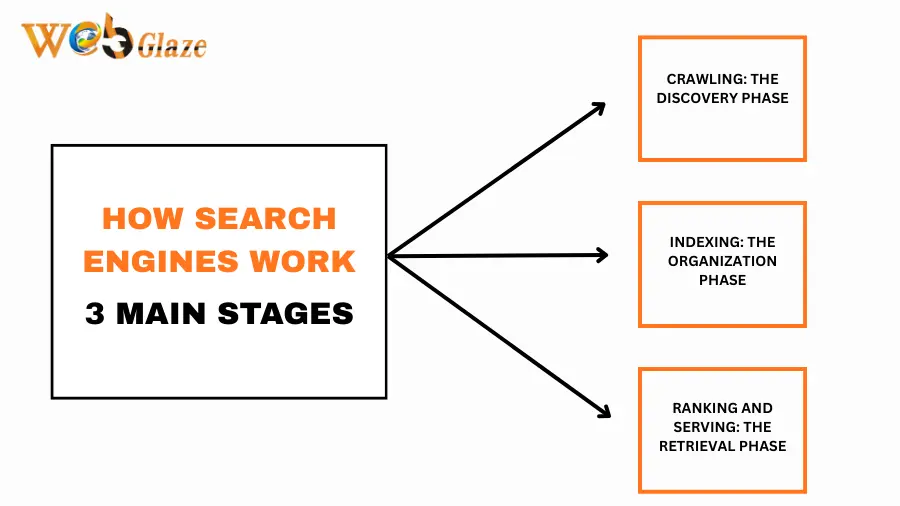
How Search Engines Work: 3 Main Stages
Are you looking for the answer to how Google Search works? You’re at the right place, as this blog will help you understand the search engine working process in the simplest way. They use web crawlers that visit websites to find, collect, and store content in a large database or index. When users search for something, they show the most relevant results from the stored or indexed content. In simple words, you can think of search engines as librarians for the internet, as they organize pages and help users find the right information.
1. Crawling: The Discovery Phase
When we understand how Google search works, the first stage we’ll discuss is crawling. In this process, automated programs that are crawlers, bots, and spiders, like Googlebot, browse the internet to find new and updated content. These crawlers start from known URLs and follow links to find the latest content, which can be pages, images, and videos.
You can consider that this stage is the base for how search engine indexing works, as bots provide the content that search engines need to provide results. This simply means Google and other engines can’t deliver results without crawlers. Search engines use a smart and automated process (algorithm) that decides which websites to visit, how many pages to look at during each visit, and how often to check for updates.
- Discovery Methods: As we discussed above, bots follow links from known pages or use submitted XML sitemaps to find new URLs or pages. Website owners can submit pages through GSC, which can help search engines discover their content faster.
- The Crawl Process: During the crawling process, the bots visit a page and download its HTML. They read the content, collect new links, and these links are then added to a list for future visits. This crawling process is repeated.
- Control Mechanisms: You might be aware that you can control bots by using a robots.txt file. This file provides instructions and tells bots which pages or sections of the site they are allowed to visit or cannot visit. Website owners can use this file to protect private information or avoid low-value pages.
- Crawl Budget: As we discussed above, search engines follow an algorithm to limit how many pages they crawl on a specific site. This limit depends on the site’s authority, server speed, and update frequency.
2. Indexing: The Organization Phase
The second stage that you need to know about to understand how Google search works is indexing. After crawling, the search engines analyze the content to decide whether it is worthy of being added to their huge database, the index. They don’t index every page, as they don’t add low-quality, duplicate, or no-index content to maintain the quality of delivered results.
Knowing how search engine indexing works is important, as a search engine chooses which content will be added to its database based on relevance and quality standards. In this process, the content is processed, categorized, and filed with metadata. By doing this, they decide whether the content is valuable enough to add to the index. Search engines ignore low-quality, duplicate, and spammy content.
- Processing and Rendering: Once the crawling stage is done, search engine crawlers process and render pages. They run JavaScript to see the final version of the page as a user would see it. This helps search engines understand the layout and content.
- Content Analysis: The engine then studies the text, images, and video files on the page. It looks at the title, meta description, headings, image alt text, and schema markup to explain the content.
- Selection of Canonicals: When multiple versions of a page exist, Google and other engines choose one main version, which is called the canonical page, and store it in the index.
- Exclusion from Index: Some pages with the no index tag are not added to the index. Generally, low-quality pages or those containing duplicate content are excluded. Such pages don’t appear in search results, as they are not stored in the search engine’s huge database.
3. Ranking and Serving: The Retrieval Phase
When a user searches or enters a query, the search engine scans data in the index to find matching pages. They use smart processes or advanced algorithms to order the pages from most to least useful. Now that you understand how search engines index, it must be clear to you that ranking doesn’t automatically start after indexing. This process only occurs when a user actually enters a search query. Complex algorithms use hundreds of factors, like the words in the query, relevance, speed, freshness, and more, to ensure the best results appear first.
- Query Analysis: When a user searches for a query, the engine first understands the search intent, like informational or transactional. Then it checks location, language, and device type to provide the most useful answers.
- Algorithmic Selection: The algorithm selects the best pages based on many factors. Today, advanced AI systems like RankBrain and E-E-A-T prioritize results based on content relevance, site speed, mobile-friendliness, and other factors.
- Serving Results: Finally, the results or ranked list are displayed on the SERP in less than a second. All the stages that we discussed to understand how search engine works make sure users only see the most relevant results that give accurate answers for their queries first.
When Things Go Wrong: Understanding Search Engine Penalties
Although there are only three main stages that you should know to understand how Google search works, you must also know about penalties. These are the negative actions that search engines take when a site violates their guidelines. It can be demoting or removing a site from the index.
These help engines to maintain an index with quality pages and display only relevant pages in SERP. Penalties can significantly drop a website’s ranking. You will lose organic traffic, which directly affects your revenue. Search engines may use a human reviewer and automated systems to detect content that violates their policies. Some mistakes you should avoid to keep your site in the search engine’s good graces are fixing content issues, like duplicate, thin, or spammy content. You should avoid overusing keywords, link schemes, cloaking, and other techniques.
Build Strong Search Visibility with Web Glaze Services
Understanding how search engines work is only the first step; you need to apply this knowledge to secure a high visibility. Those who lack experience in planning and implementing a strong SEO strategy might face issues. However, with a trusted partner, you don’t need to struggle with technical and content issues and common SEO mistakes that can lead to penalties.
Connect with Web Glaze Services to get expert help that improves your brand visibility through smart SEO strategies. We work on every aspect, from crawling and indexing to content alignment. We make sure search engines can easily find and understand your pages. Our team focuses on every element to improve your search performance and user experience.
Also Read:

